Safety
Horses Are Not Bicycles: Wear the Right Helmet
Sep
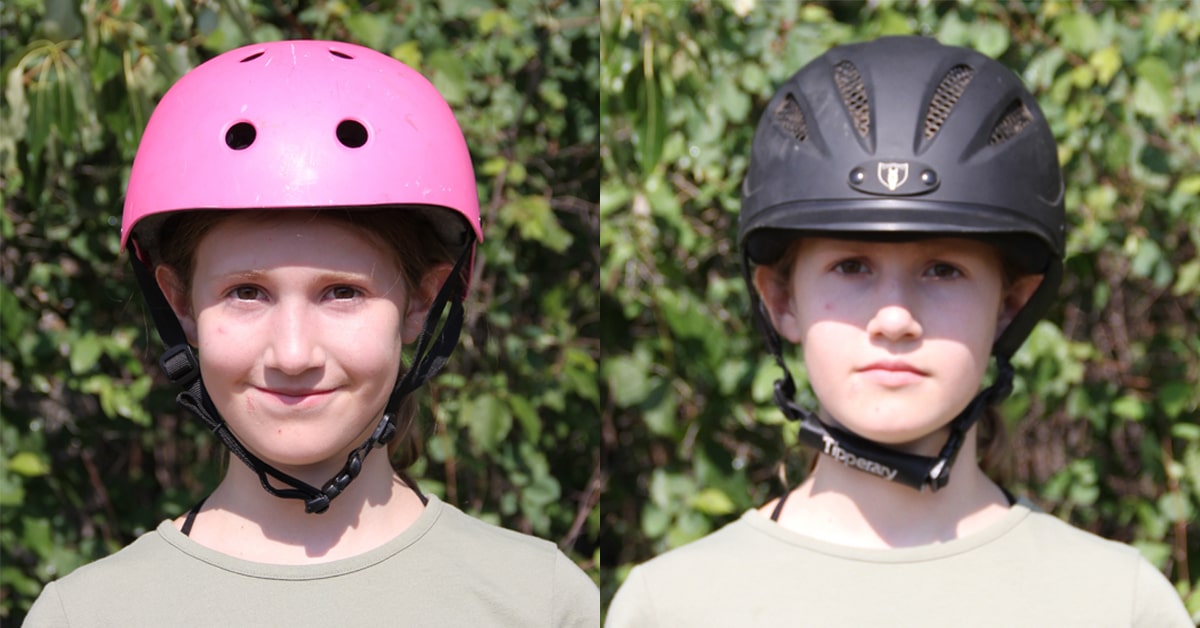
The Horse Canada has published a good article about why horse riders should not use bicycle helmets. Some riding stables and camps allow kids to wear bicycle helmets in lieu of equestrian helmets; here is why that is a bad idea.
The Difference In Protection
Bicycle helmets are designed to sustain impact from the height of a fall from a bicycle, which is approximately five feet. The protection on these helmets focuses on the front, as most falls from a bicycle are forward motion falls that result in the cyclist going over the handlebars and falling head first to the ground.
In comparison, equestrian helmets are designed to withstand a fall of approximately ten feet, which is the approximate height when falling from a horse. There is also additional protection to the sides and back of the head, as many riding accidents involve equestrians falling to the side or landing on their backside and hitting the back of the head. Equestrian helmets are also made with a hard, outer shell which is designed to help protect the helmet from additional impacts such as a horse kick or sharp hoof stepping on the helmet. Bicycle helmets are made with a microshell, which will not withstand a sharp hoof or kick.
Helmet Testing
In regards to helmet safety, there is more to it than meets the eye. Depending on the type of sport a helmet is used for, testing laboratories determine the test area for a helmet. Not every part of a helmet is designed to take the full impact of a crash. Each helmet standard ‒ motorcycle, bicycle, equestrian ‒ precisely outlines how much of the helmet must meet impact standards.

(Graphic courtesy of Charles Owen)
This is done down to the millimeter. A technician draws a test line around the helmet with a marker. All impacts are fair game on or above this line. Some standards mandate a relatively low test line, requiring greater portions of the helmet to withstand full impact.
The test line area for bicycle helmets, the area where the helmet is impacted, is much higher on the head than equestrian helmets. As a result, there is less coverage and not as much protection on the lower part of the helmet. While all test helmets are impacted onto an anvil, an equestrian helmet is also tested on a hazard anvil, which is much sharper than the curb anvil used for bicycle helmets. The hazard anvil is used to test the possibility of a sharp hoof coming in contact with the equestrian helmet.
Equestrian helmets are also tested for penetration, which involves a 3kg 60-degree point spike dropped from 0.75 m, as well as a lateral crush test. Bicycle helmets do not endure these additional tests.
“In our published studies, we found in equestrian accidents, there are a lot of impacts around the test line area. If these people were wearing a cycle helmet, those impacts would have been on the head rather than the helmet. A cycle helmet test line is much higher than an equestrian helmet test line, which means that a cycling helmet has less protective coverage,” says Stewart.
According to a study published by the Journal of Neurosurgery, horseback riding is the leading cause of sports-related traumatic brain injuries. The University of Connecticut states head injuries are responsible for more than 60% of horse-related deaths and the most common reason for horse-related hospital admissions. The American Medical Equestrian Association calculates that ASTM-approved helmets reduces riding-related head injuries by 30% and severe head injuries by 50%. As a result, it is important to choose a helmet that is sport-specific and meets the safety standards for that particular use.
Keeping Equestrians’ Brains Protected – A Checklist
- Ensure you are wearing a helmet designed specifically for equestrian use and meets one of the four equestrian safety standards; ASTM, PAS015, Snell or VG1. If you live in North America, your riding helmet must meet the ASTM or Snell safety standard. If importing a helmet from Europe or the United Kingdom, their safety standards may not be recognized in North America.
- Understand that some equestrian helmets may be discipline specific, e.g. jockey skull helmet designed for eventing.
- Ensure your helmet is professionally fitted. Most tack stores have a professionally trained fitter on staff. A well-fitting helmet should have a snug fit, with even, firm pressure around the entire head. The helmet should sit level on the head, covering the forehead leaving about an inch above the eyebrows.
- With the harness unfastened, the helmet should not rock forwards or backwards. Once fastened, the chinstrap should sit just under the chin and gently touch the bottom of the ear lobe, avoiding the throat. You should be able to put a finger between the strap and your chin. Any more than one finger width means the helmet will not be able to do its job if an accident occurs.
- Putting your hair up under your helmet affects the fit. Ideally, an equestrian helmet is designed to protect and fit properly with hair hanging down and secured in a low ponytail. If you have long hair and ride with it up only occasionally, i.e. at horse shows, you might need a second helmet. Otherwise, your helmet will be too big for your head when your hair is down. When you do put your hair up, make sure that the hair tie is low on your head and not inside the helmet to avoid any pressure points.
- Don’t be tempted to buy your child a helmet that is a size too big so that it lasts longer and they will ‘grow into it’. As with adults, a child’s equestrian helmet must fit snugly on their head for every ride, otherwise it is simply not safe.
- Replace a helmet after any impact. Every impact, no matter how small, causes the microbubbles in the expanded polystyrene (EPS) layer of the helmet to burst. This is what protects your head the most in the event of a fall. In some cases, the damage may be invisible to the naked eye. Check directly with the helmet manufacturer, as they usually have a discounted helmet replacement policy.
- Replace your equestrian helmets every five years. Even if you haven’t had a fall in a helmet, its protective properties degrade over time. After five years of life, an equestrian helmet is no longer deemed safe and should be replaced.
- Store your helmet properly. When you’re not riding, keep your helmet safe by storing it in a cool, dry place. If it’s wet after a ride, leave it out to dry fully before putting it away to avoid mold and rust. Never leave a riding helmet in a hot car or in direct sunlight. Extreme heat risks melting the high-grade polystyrene layer inside the helmet. Likewise, temperatures below -20 C (-68 F) will cause damage.
- Ensure that you always wear your helmet any time you are working around horses, and not only when mounted. Remember, you only have one brain!
To read the full article on The Horse Canada, please click here: https://horse-canada.com/magazine/rider-health/horses-not-bicycles-wear-right-helmet/
