General, Horse Feed
PBITG.com: Exercise and Feeding During MCO
Apr
Zack’s Tack’s Managing Director, Peter Abisheganaden writes in his PBITG.com: Everyone in Malaysia has been affected by the Movement Control Order that is in effect till 14th April 2020. There is talk it could be extended further, as we combat Covid-19. No one knows when we will return to normalcy. What does this mean for your horses?
The Need for Exercise
Almost all horses are stabled in Malaysia. We do not have the luxury of turning them out. Floats are not running during this MCO, so sending them off to the Stud Farm or Cameron Highlands for a spell is not an available option.
Every horse show, endurance ride and polo tournament has been put on hold. That means there are no immediate targets, and therefore, no training and fitness objectives.
Exercise is scaled down from fitness conditioning to maintenance exercise or even paddock rest. With some clubs in complete lockdown, owners may not be able to ride their horses. What then?
Stabled horses cannot be locked up for days on end. Stable rest is jail for horses. They must be exercised or at least walked, if not paddocked.
If horses are not exercised, they run a higher risk colic. In fact, speaking to a vet from a successful practice yesterday, he told me that they have had to put all elective work on hold as they have to attend to an increasing number of colic cases.
Stabled horses cannot be locked up for days on end. Stable rest is jail for horses. They must be exercised or at least walked, if not paddocked.
If horses are not exercised, they run a higher risk colic. In fact, speaking to a vet from a successful practice yesterday, he told me that they have had to put all elective work on hold as they have to attend to an increasing number of colic cases.
Exercise helps digestion. Kentucky Equine Research has authored an article titled, Gastrointestinal Motility Key to Horse Digestive Health. (Motility is the ability of an organism to move independently, using metabolic energy. This is in contrast to mobility, which describes the ability of an object to be moved. Motility is genetically determined, but may be affected by environmental factors).
It states, “The exercise horses receive while grazing is thought to positively impact gastrointestinal motility.”
The Holistic Horse says, “Horses need to move to enhance the motility of the feed through their systems. Exercise and turnout are extremely important for gut function; after all, horses in the wild travel anywhere from 20 to 40 miles in a day.”
The Horse.com has a good article about the danger of impaction colic caused by decreased motility. In Impaction Colic: Blocking the Way, it says:
“Alterations in motility, water content within the colon, and changes in exercise are all considered as possible risk factors,” says White of colic. “The problem appears more common in mares and middle-age horses. Events associated with the impaction include management changes within two weeks prior to signs. One of the most frequently reported management changes is sudden restriction of exercise due to a musculoskeletal injury, including hospitalization or restriction of exercise after surgery.”
One study reported recent stall confinement was associated with 53.7% of impaction colic cases; another study found 62.5% of colon impactions occurred within two weeks of significant management changes, such as stall confinement or transport.
Confinement might have multiple adverse effects on equine intestinal function. Stalled horses often experience inconsistencies in feeding intervals and amounts relative to their previous management.
“Ingestion of indigestible non-feed material such as shavings, sand, gravel, hard seeds, hair, pieces of rope or twine, and pieces of rubber can also lead to GI impaction. Although most horses would not eat these materials, some may develop vices due to conditions such as prolonged stall confinement or hunger. Thus, the time horses are kept in stalls should be minimized.”
 The Take-Home Message from this article was, “Optimally, horses should be fed a diet with a minimum of 60-70% forage,” says White. “This means feeding only pasture or hay, and only feeding grain when necessary. High-quality hay will provide adequate protein for most horses. The horse’s intestine doesn’t always tolerate acute changes in diet, so when a change is necessary, the transition should be made over time, normally seven to 10 days.”
Feed to your Need
Now that we understand the higher risk of impaction colic, what can we do to minimise this risk?
Ask yourself these questions:
- Reconsider your horses’ feed. In this time of limited exercise or decreased work, does your horse need the same high energy feed as when they are in competition? Should you make a change? If so, the next few questions will assist you in reformatting your feeding plan for your horses.
- What is its ratio of forage to hard feed? If you are aiming for that 60-70% of forage, how are you accomplishing it? If you horse gets a total of 10 kg of feed a day, and 5 kg of that is your high energy hard feed, especially in this MCO period, you may wish to gradually rebalance it to about 7 kg of forage and 3 kg of hard feed.
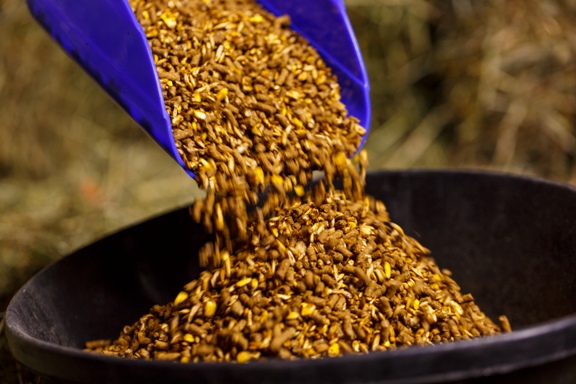
- Can you make easy changes without changing your general feed program? KL Academy of Polo’s 20 horses and the 7 privately owned horses I am in charge of are all fed with Zack’s Tack Polo Mix, an extruded rice bran product locally made for us by ENA. This is the ‘hard feed’ component they are fed with. With no lessons and no polo, we are shifting half of their hard feed to the lower spec Zack’s Tack Horse Cubes. It is a lower energy pellet that better fits their MCO energy requirements. It is also made in Malaysia but is a corn meal, corn flour and wheat pollard mix. To be clear, we are still feeding them with Polo Mix, just replacing half of it with Horse Cubes. As the Horse Cubes are cheaper, it actually reduces our feeding bill.
- What are the fibre forages that are available in Malaysia? Most clubs offer hay as the standard forage. Some clubs still feed chaff, though it is generally accepted to be a more expensive and qualitatively less ideal forage than long-stemmed hay. Hay is still relatively expensive as it is an imported product. There are different types of hay available. Timothy Hay is the most popular forage in Malaysia, but there is also Bermuda (grass hay) and a higher spec Lucerne hay available. Haylage is another alternative forage. Super Fibres are top of the list for owners in the know. Speedibeet and Supa Soy are top quality forage supplements that can be used.
 Locally, Supa Soy Pellets is another high fibre alternative that is offered at a much better price than Speedibeet. KL Academy of Polo and my own horses have started using Supa Soy Pellets, replacing an equivalent quantity of hay. Of our horses’ forage requirements, we now feed 50:50 hay to Supa Soy.
Supa Soy is soaked in warm water for about 5 minutes before you feed it. It doubles in weight from the soaking.
Supa Soy Pellets are a scientifically formulated Super Fibre Pellet. They are 100% Soybean Hull from human grade soy beans.
This product is a highly digestible fibre with a low glycaemic index, meeting energy requirements yet reducing diet related digestive issues.
Its low starch content makes it ideal to feed all types of horses and will improve digestive health by being readily fermented in the hindgut, producing volatile fatty acids which provide a steady stream of slow release energy.
Again, this is a cost saving as the per kg cost of Supa Soy is cheaper than that of Timothy or Bermuda Hay.
FYI, Zack’s Tack Polo Mix, Zack’s Tack Horse Cubes and Supa Soy are all export grade products, licensed for export to Australia.
Conclusions
It is important to remember that not all horses are the same. As KER states, “Selecting the right forage for a horse depends largely on its energy needs. A hard keeper might require a calorie-dense legume, like alfalfa (lucerne) or clover, or lush pasture. On the other hand, an overweight pony might do well on a mid-quality hay and very little pasture.”
Remember, if you are going to change your feed, do it gradually. Remember the 12 Rules of Good Feeding.
Most important in a feed change is that you remember Rule #4: All changes in feed should be made gradually over 10 days to two weeks.
If in doubt, consult your vet.
