General, Horse Feed
Stable Science
Jul
I think it is important that as we learn things, we apply that knowledge to our horsemanship, stable management and horse husbandry. As much of the northern hemisphere goes through a heatwave, they experience the high heat and humidity we live with.
In Malaysia, we introduced the free change of horses, midway through a chukka. This was adopted by FIP for all events after it worked so well the 2011 FIP World Cup Zone D Playoffs, and at the 2012 Super Nations Cup in China. It is now mandatory at all competitive FIP tournaments.
In 1996, the Atlanta Olympic Games, misting tents were used to bring done ambient temperatures. I introduced this in Malaysia when we started the RMPA International League, and most good clubs we have used it ever since.
Even the science behind rapid cooling has changed. It has now been proven that when you put water on a horse to cool it quickly, it is actually better not to scrape it off and apply more as we used to do to bring core temperatures down. Leave the water on, and add more cool water over it. No scraping off is the new science.
Heat, and the effect it has on cells and tendons has been a hot topic recently. The studies were done in temperate climates, while we deal in the high temperature tropics. I have stopped the use of fleece bandages in daily use, opting to use open front boots if we are stick and balling, or no boots at all, if we are just doing light work.
Many owners and teams still work daily in fleece bandages. They are a big culprit in retaining heat in the horses’ legs, especially if they are not taken off immediately after work. Perhaps it is a case of old habits dying hard that horses, rain or shine, still come out to work in them daily.
Another old habit is the use of oats. Oats was traditionally fed to horses for its protein content. The hull or husk, is not digested though, and digestibility is only around 60% for crushed oats, slightly less if they are clipped and dressed. Many horses have a poor reaction to starch, which is why many horses on oats will become ‘fizzy’ or hyperactive.
 Years ago, the horse industry moved away from oats and towards muesli feeds, which is how I would describe the likes of Mitavite Sustaina, Hygain TrackTorque or Zack’s Tack’s Pro Sport Mix. There are oats in those feeds, but they also offer more digestible and accessible sources of protein.
Stabilised Rice Bran (SRB) is scientifically a fantastic feed for horses. Being an extruded feed, it has already been cooked, therefore digestibility is almost 98% in SRB. That means your horse has access to almost all the goodness it eats, rather than excreting a large number of hulls or whole oats. I’ve used Zack’s Tack Polo Mix since the 2007 SEA Games. I have yet to find a better feed.
Then there are those who feed horses a conditioning mix during a tournament. The time to put condition on your horse is before, not during the tournament. It is the clean energy your horses need during a tournament, not a feed to pack the weight on.
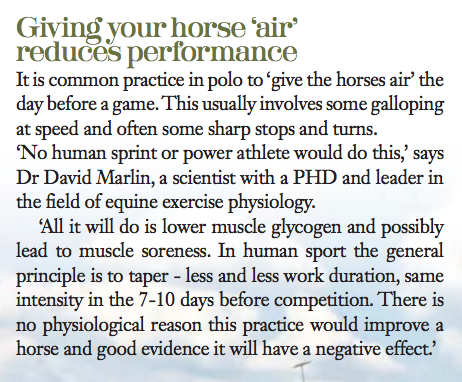
‘Giving Air’ is another practice I see old fashioned teams do. It was a common practice to ‘give horses air’ the day before a game. This usually involves some galloping at speed and often some sharp stops and turns.
‘No human sprint or power athlete would do this,’ says Dr David Marlin, a scientist with a PhD and a leader in the field of equine exercise physiology.
‘All it will do is lower muscle glycogen and possibly lead to muscle soreness. In human sport, the general principle is to taper – less and less work duration, same intensity in the 7-10 days before competition. There is no physiological reason this practice would improve a horse and good evidence it will have a negative effect.
No trainer would ever dream of galloping their racehorses the day before a race. Yet we still see so-called professionals galloping their horses the night before a big match. I wonder if their patrons know what they are doing, or know the science why this is detrimental to top performance.
